In modern marketing, the term “Storytelling” has moved beyond being a mere buzzword to becoming a core strategy for brand building. Why is it considered more important to tell a “story” than to simply explain the superiority of features or price? This article comprehensively explains the definition of brand storytelling, its psychological background, and the power of this method through successful case studies.
1. Introduction: The Power of Stories イントロダクション:物語の力
Since ancient times, humans have shared information and deepened community bonds by telling stories around campfires. Stories are not merely entertainment; they are cognitive frameworks for understanding a complex world. In the context of marketing, consumers respond strongly not to inorganic “data,” but to “stories” with context.
In a modern society overflowing with information, a simple list of product specifications does not remain in the memory of consumers. However, stories about “why the product was born” or “what difficulties were overcome” create an emotional connection and have the power to foster brand attachment (loyalty).
Brand storytelling can be defined as “a communication method that conveys a brand’s values, mission, and reason for existence in an emotionally moving narrative format.”
This does not simply refer to airing touching short dramas in commercials. It means Bdeploying a consistent narrative across all touchpoints, including the founder’s thoughts, the behind-the-scenes of product development, the changes customers have experienced through the product, and the role the brand intends to play in society.
While traditional marketing focused on “What” to sell, storytelling focuses on “Why” the brand exists and what role it plays in the customer’s life.
There are three main factors behind why companies emphasize this method.
Commoditization of Information and Difficulty of Differentiation
With the advancement of technology, functional differentiation of products has become increasingly difficult. Every smartphone has high image quality, and every detergent removes stains. When differentiation by function reaches its limit, the only unique differentiation factor becomes the “brand’s inherent story.”
Consumer Avoidance of Advertising
Due to the flood of digital advertising, consumers have become defensive against “selling.” However, stories are accepted not as “selling” but as “content.” People skip ads, but they voluntarily listen to interesting stories.
Emphasis on Emotional Value
Especially among Millennials and Gen Z, “empathy” and “ethics” are becoming important in consumption behavior. When a company’s vision or stance on social contribution is told as a story, consumers come to view purchasing that brand as “part of their identity.”
4. The Effects of Brand Storytelling (Psychological Basis)ブランドストーリーテリングの効果(心理学的根拠)
The effects of storytelling are supported not only by empirical rules but also by psychology and neuroscience.
Memory Retention Rate
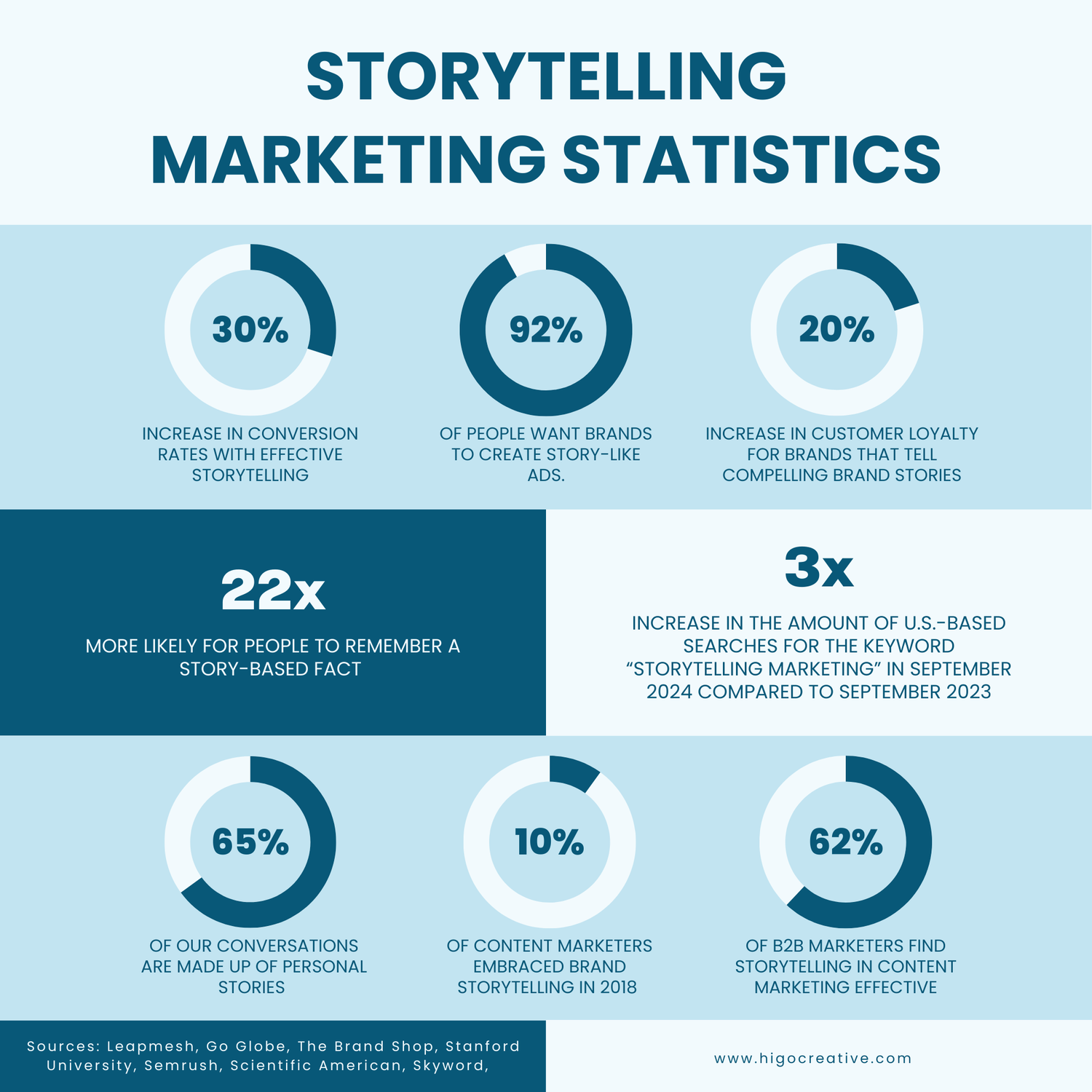
According to research by cognitive psychologist Jerome Bruner, facts are 22 times more likely to be remembered when presented as part of a story than when presented in isolation. Because stories activate multiple regions of the brain (not just the language center, but also areas governing senses and movement), they leave a deep impression.
Figure 1: Storytelling Marketing Statistics Source: Higo Creative – Storytelling Marketing Statistics Information presented as a story is overwhelmingly more memorable than a mere list of facts and creates an emotional connection with consumers.
Secretion of the Empathy Hormone “Oxytocin”
According to research by neuroeconomist Paul Zak, when humans are exposed to moving stories, the neurotransmitter “oxytocin” is secreted in the brain. Oxytocin works to increase trust and empathy, and when it is secreted, people become favorable toward the subject and are more likely to take cooperative actions (such as purchasing or donating).
Figure 2: The Science of Storytelling (Infographic) Source: Smart Insights – The Science of Storytelling Data showing the impact of storytelling on the brain and its effectiveness in marketing.
5. Success Stories 成功事例の紹介
Let’s look at examples of companies practicing excellent brand storytelling.
Apple: “Rebellion Against the Status Quo”
Apple has not talked about product specs (memory capacity or CPU speed) but has always told stories of “creativity” and “breaking the status quo.” The famous “1984” commercial and the “Think Different” campaign provided customers with a story that using Apple products is not just using a tool, but becoming one of the innovators.
Airbnb: “Belong Anywhere”
Airbnb’s brand message is “Belong Anywhere.” They emphasize not the cheapness of accommodation, but the interaction between hosts and guests and the story of “living like a local” while traveling. By having customers share their own travel stories as User Generated Content (UGC), they are forming a powerful community.
Nike: “There is an Athlete in Everyone”
Nike’s “Just Do It” is not just a slogan, but a story of the “Hero’s Journey” where everyone challenges their limits and overcomes them. Their advertisements often depict unknown athletes grabbing success after much effort, positioning the customer themselves as the protagonist of that story.
Nikeの「Just Do It」は、単なるスローガンではなく、すべての人が自分の限界に挑戦し、それを乗り越えるという「ヒーローズ・ジャーニー(英雄の旅)」の物語です。彼らの広告はしばしば、無名のアスリートが努力の末に成功を掴む姿を描き、顧客自身をその物語の主人公として位置づけます。
6. How to Practice Brand Storytellingブランドストーリーテリングの実践方法
To practice effective storytelling, the following frameworks are useful.
Simon Sinek’s “Golden Circle”
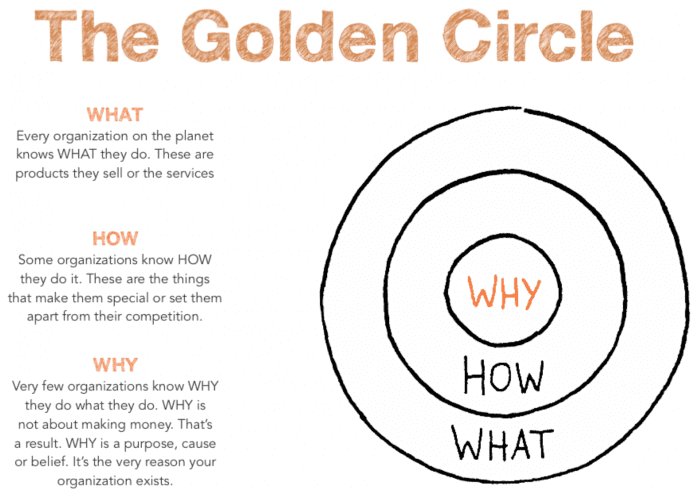
The “Golden Circle” theory proposed by marketing consultant Simon Sinek strikes at the heart of storytelling. Many companies start speaking from “What” (what they sell), but great leaders and brands start speaking from “Why” (why they do it).
Figure 3: Golden Circle Model (Proposed by Simon Sinek) Source: Smart Insights – Golden Circle Model Communicating from the inside “Why” to the outside is the key to motivating people to act.
Why (Belief): We believe we can change the world.
How (Method): To do that, we make products that are beautiful and easy to use.
What (Product): That is this computer.
Make the Customer the Hero
A common mistake is for the brand itself to behave as the “hero.” The protagonist of the story is strictly the “customer,” and the brand should be the “mentor” or “magical tool” that helps in that journey. In Star Wars terms, the customer is Luke Skywalker, and the brand plays the role of Yoda.
7. Analysis: The Future of Storytelling in the Digital Age考察:デジタル時代におけるストーリーテリングの未来
The evolution of digital technology is changing the form of storytelling. Instead of one-way narration, “participatory” storytelling through social media has become mainstream.
Also, with the rise of generative AI, mass production of content has become possible. However, precisely because of this, the value of “Authenticity” is rising. Rather than perfect sentences generated by AI, stories based on truth, even if clumsy but human, will be sought after. Companies are questioned more than ever about their integrity to maintain transparency and continue telling stories without lies.
In the future, immersive storytelling utilizing VR (Virtual Reality) and AR (Augmented Reality) will also develop, and it is thought that customers will become subjects who “experience” stories rather than just “listening” to them.
Brand storytelling is a powerful method for providing customers with emotional value beyond functional value. Humans instinctively seek stories and understand the world through stories.
By starting with “Why,” positioning the customer as the protagonist, and weaving a consistent and authentic story, a brand can secure a special place in the customer’s heart. In the rapidly changing modern world, the key to building a strong brand that does not fade can be said to lie exactly in this “power to tell stories.”
I selected the Tokyo Christmas Market 2025 because it is one of Tokyo’s most famous winter events, attracting families, couples, elderly visitors, and many foreign tourists. It takes place in an open outdoor park with wide walking paths and easy access from several train stations.
Friendly design for elderly visitors and families
Multicultural and multilingual support for tourists
A festive Christmas atmosphere everyone can enjoy
confirm during visit
The Tokyo Christmas Market is one of the most popular seasonal events in Tokyo, featuring food stalls, hot drinks, handmade crafts, and festive decorations. It is enjoyable for families, couples, seniors, and international visitors.
Hibiya Park is located in central Tokyo with multiple train lines, many elevators, and flat walking paths. It is easy to reach even for:
People with walking difficulties
Wheelchair users
I arrived at Hibiya Station around 5:30 PM. The entrance to the event was clearly marked with lights and signs. The pathways were wide, and even with many visitors, there was enough space for wheelchairs and strollers.
The market had a warm and festive atmosphere—decorated wooden stalls, Christmas music, and the smell of hot chocolate and German sausages. I saw many families, foreign tourists, and elderly couples enjoying the event.
The Tokyo Christmas Market 2024is an excellent example of a winter event that is enjoyable and accessible to a wide variety of people. Its barrier-free pathways, multilingual support, family-friendly design, and welcoming atmosphere make it easy to go and easy to use for people with disabilities, foreigners, elderly visitors, and families.